Earnest Echoes: How We Plan Our Summer as a Homeschool Family

Earnest Echoes: How We Plan Our Summer as a Homeschool Family

Originally posted 07/02/2022

Anyone else hit summer and look for ways to have some structure but not over-structure? Me. I am anyone else. Homeschool ends, and then I feel overwhelmed – “What do I do for summer?!” I want my children to feel like they are more relaxed, and to be able to differentiate from homeschool. We will not do any formal full lessons and I will give them time to be bored because boredom is not a bad thing. I do not want the summer to pass and also feel like we have done nothing.

I have three children, 12, 7 and 4. I included them in the planning and set specific goals for each day. Now these goals will not rule our whole schedule as vacations, summer camps and other events will definitely happen but we will have a loose plan for each day. I am not sure about you but by breakfast each day my kids are asking “what are we doing today?” and they are typically not satisfied with “nothing.”

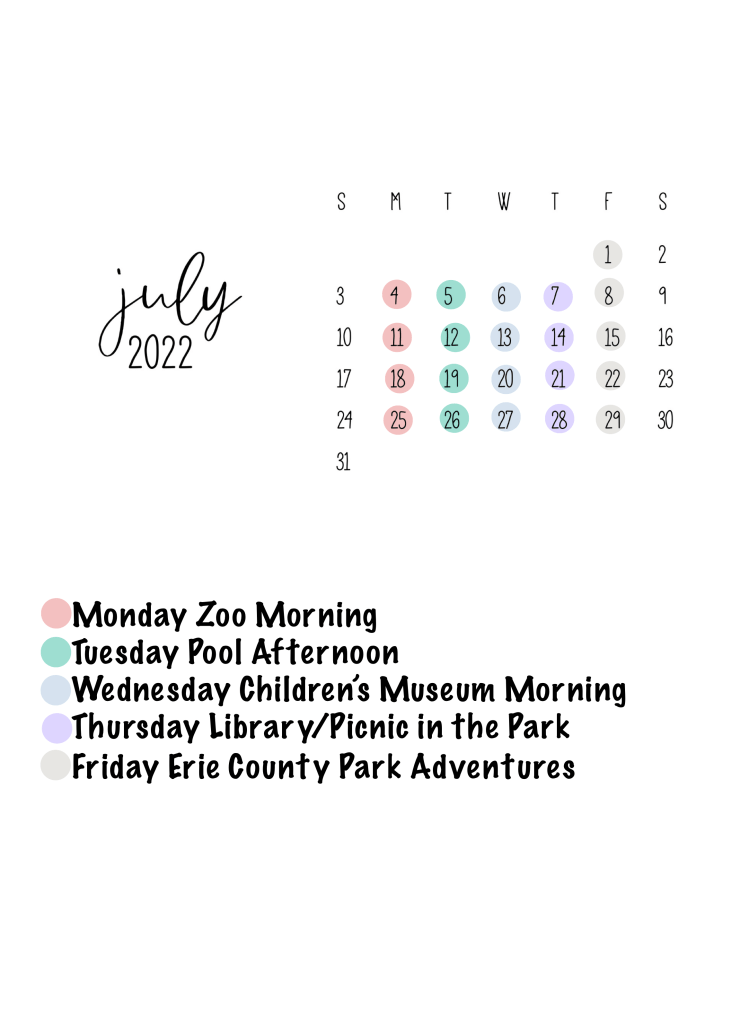
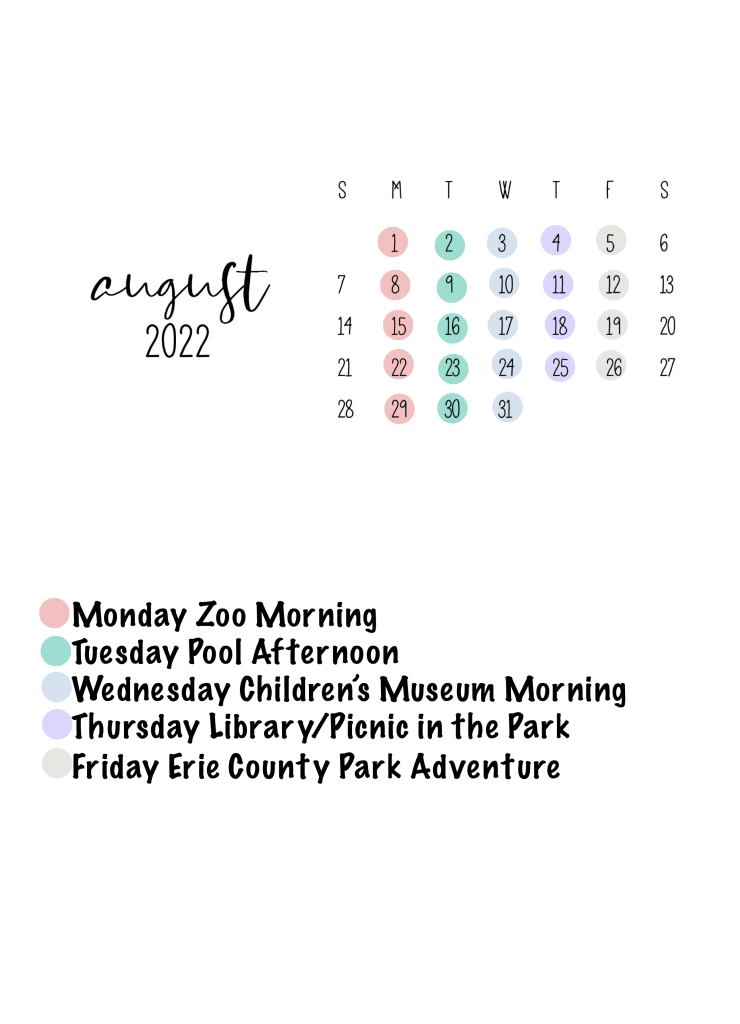
Here is what our summer schedule looks like for the months of July and August. Mondays are zoo mornings (we get a membership to the local one each year), Tuesdays are pool afternoons (we have a small pop up one otherwise it would be dedicated water play outside). Wednesdays are mornings the the museum (again we have a membership to the local children’s museum but we will also explore our other museums as well). Thursdays we will visit the library and a park nearby hosts picnics in the park with family entertainment for free. Fridays are our adventure day, we will be checking a new local park or two (we will also blog and rate our experience for those local to Erie County Pennsylvania).

Using the Notability app on my iPhone I created these fun color coded calendars (I also use similar ones for our homeschool year), I then took advantage of the $0.99 magnet deal on the Shutterfly app to create magnets as a reminder for the fridge.

This helps us have an intentional and focused summer not being limited by what we plan, but if we feel like we have nothing to do it helps to have a plan already! Let me know your tricks to keep summer fun and easy for your kiddos.

x. earnest mom

Status

The Hands of a Parent

The Hands of a Parent

Recently, I was walking with my 7-year-old, hand in hand.  As I was getting us from our parking spot to our destination I started to think about the action of our hands in parenting.  Our hands are essential in the process of raising children, from birth until they move out—they remain involved throughout our parenting journey.

Breaking it down into ages and development levels, our parenting approaches can be hands on or hand off if we choose.  From helping hands to cheering hands, let’s explore how we HAND-le parenting our little humans.

Helping Hands start from birth, your baby is born and right into your hands when they arrive.  When holding a baby, they are completely and beautifully dependent on us.  From holding bottles or breast, diapers or burp cloths, baby’s contact is holding hands all through those early formative months.  We stroke a cheek, wipe a bottom and lift to hold them heart to heart with us in comfort and love.  Cradling and holding are so intimate and build the parent-child deep connections in their growing brains.

The next stage is Hand Over Hand.  Baby begins to crawl and toddle, causing us to follow closely and help them to learn the safety and dangers of the world around them, keeping our hands over their hands.  Leading them directly by touch and our words we teach them as they explore their surroundings. 

The third stage is Holding Hands.  Just as I was earlier with my little guy, holding hands allows us to be side by side with our child.  We are holding to one hand, still guiding and leading but also allowing them to lead in small spurts as well.  We are still tethered to them hand in hand so when they misread safety signals, we are still there to stop to prevent danger but still a bit more freedom.  I love the image of side by side, next to one another, still intimate yet slightly more independent.

By the fourth stage we find ourselves with Guiding Hands.  We have led and shown over and over, creating neural pathways of routine, expectations and a life of relationships, working and playing.  As we guide our children, we gradually let go, and they may push us away a bit.  They will begin the stages of, “You do not have to walk me to the bus anymore, just watch from the porch,” or “Please do not hug me in front of my friends.”  We are quite hands off here, but we are close enough that when we may need to catch them, hold them or show them a safe way – we still can.

Parenting in the next stage is Waving Hands.  We are on the sidelines, allowing harmless mistakes where we can still scaffold and advise before leaving home.  We are coaching, up until now we have helped them develop an array of tools to use when facing life, but they are still in our home, so we can still come together and review and give help on an ongoing basis.  I always remind my children in the younger years, there is nothing they can do to make me love them less – nothing.  Building a foundation of trust knowing they can come to me with anything at all.  As we watch our children at this age, almost adult, we will get glimpses of the man or woman they are becoming and yet we can still offer tips and coaching as they grow – waving to remind them “I am here!”

The final stage is Cheering Hands.  Here our children are leaving home, finding their own path and growing their own family.  A parent’s role continues throughout their life, but during this period, they can observe and support from the sidelines – get ready to cheer!  Cheer them through post-secondary education or into careers, starting a family and becoming the man or woman they were called to be.  As a child, I remember my games, plays, and presentations at school, with two working parents, my grandparents were always in the audience – cheering me, they were also cheering my parents.  Celebration happens so much in adult milestones, graduations, job offers, big moves, showers, weddings, etc.  This is a time where parents get to celebrate and watch the hard work of those early blurry days pan out before their eyes.

Our hands play such an important role in parenting, and it is essential for children to rely on them. Whether it is the touch of a baby’s bitty fingers, holding hands while crossing a street, or applauding in support, our hands contribute significantly to our children’s development. In my indigenous culture, it is believed that every action has an impact for the next seven generations, which highlights the long-term role of parental actions – our hands.  You mama, you will be known by your 5-times-great-grandchild by what your hands do today.  How beautiful.

Guest Feature: What’s Best for Your Health??

Guest Feature: What’s Best for Your Health??

Thank you to Daniel Sherwin from dadsolo.com for sharing this article with us: Tips for Taking a Stand Regarding What’s Best for Your Health. Excellent advice and food for thought!

The state of our health can easily be neglected. However, when we feel terrible, it’s then that we decide to be more proactive about what is conducive to our health and what isn’t. In other words, we learn to take notes regarding our health because we know ourselves and our family better than anyone else. So if that’s you, and you’ve been letting everyone around you decide what’s best for you or your kids, here are some helpful tips from earnest mom on how to voice your opinion more.

What are your options?

Taking care of your health better means being aware of the various options available to you when choosing a health insurance scheme. There are quite a few options out there, so you might want to consider doing a fair bit of research into what a Health maintenance organization is (or HMO), what an Exclusive provider organization (or EPO) is, and what your options are regarding point-of-service (or POS) plans. As you can see, knowing what these are and what this entails can be quite the process to go through, let alone understand. However, research like this can end up saving you in the long run – and not just from a money perspective.

Develop a relationship with your doctor

Trust can only be built where there is open communication and honesty between two parties. The same could be said of the relationship between you and your medical health practitioner, meaning you can’t learn to trust and accept when there hasn’t been an ongoing rapport between you and them. 

Ask for a copy of your medical records

Did you know that you are well within your right to ask for a copy of your medical records? Just having your own medical records on hand to refer back to could be what you need to request a second opinion if your gut doesn’t feel right. 

Speaking of gut feel…

Suppose that you feel that your first diagnosis wasn’t entirely accurate for some or other reason, then it’s perfectly acceptable to ask for a second opinion from another physician to confirm your suspicions or allay your fears. For example, you could consult with an online doctor if you want to consult with someone urgently. Furthermore, you will have access to various treatment options if you see one that you think could be beneficial for you or your child’s condition. Also, if your child needs their medication quickly, your online doctor can complete a prescription quickly for you and have this sent to your local pharmacy, where you can conveniently collect this along with your child’s medication.

Step up.

Sometimes, we just need to step up to the plate when it comes to our health and our families’ health by being more intentionalabout it. This may mean making the most of every opportunity to exercise, such as taking the stairs and not the lift, and getting off the train or bus a stop or two earlier so you can walk the rest of the way to work, for example, or by making jogging a daily exercise that is mandatory for you and the kids so that you can bond and get fit together.

At the end of the day, it is up to us as moms to take a stand for our families’ as well as our own health by making smarter choices. This can only assist us in being better parents, knowing we have done all we can to secure the well-being of our loved ones.